Culture & film
Visovac Monastery: The Franciscan Island in Krka National Park
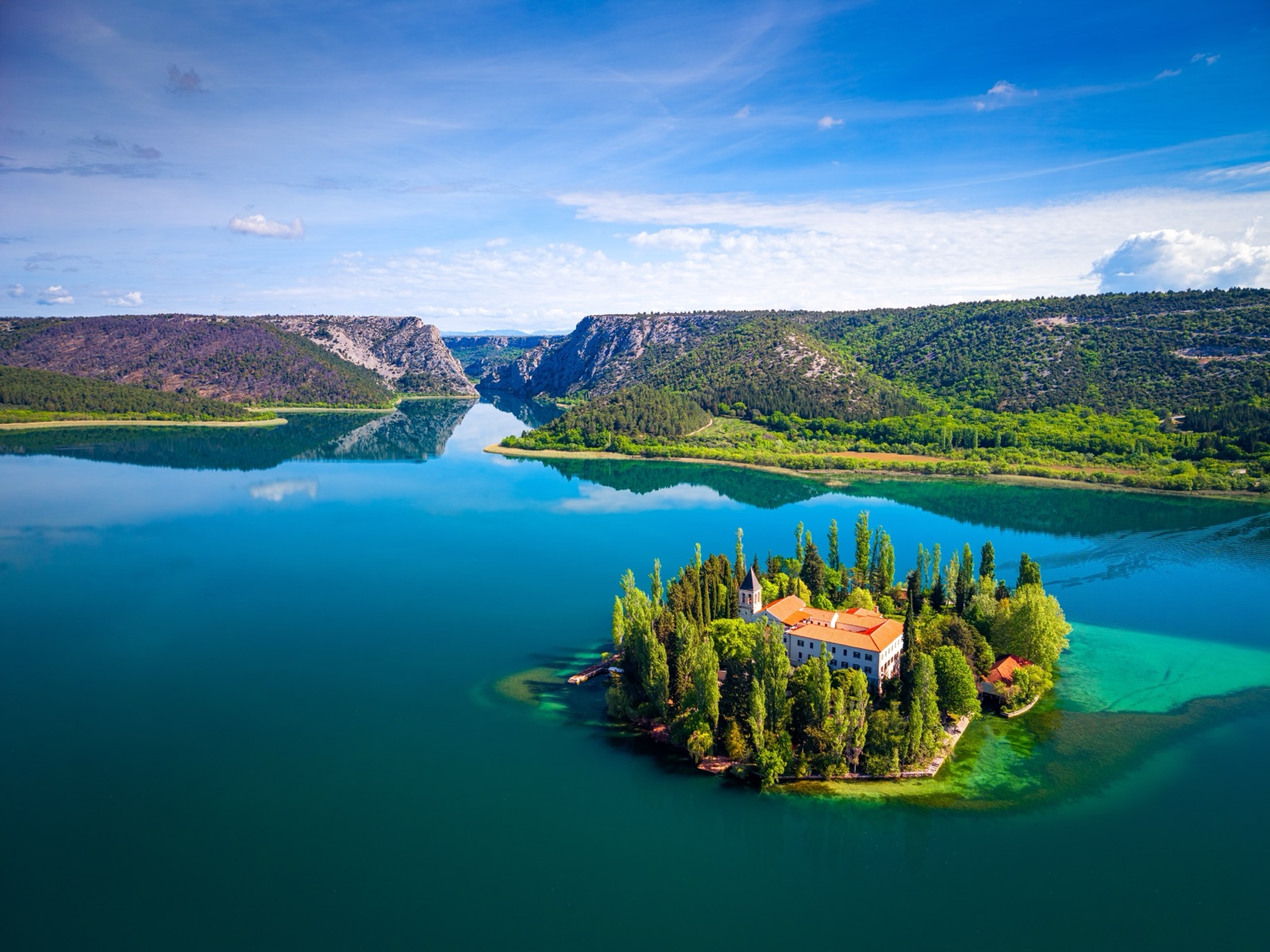
Visovac monastery is the Franciscan monastery of Our Lady of Mercy, on the small island of Visovac in the middle of Visovac Lake, a calm, lake-like stretch of the Krka River inside Krka National Park. Augustinian hermits lived there first, from the fourteenth century; Franciscan friars arrived around 1445 and have lived on the island, with a few forced absences, ever since. The island is reached only by boat: on the park’s excursion from Skradinski buk, which allows half an hour ashore, from Roški slap upstream, or by a five-minute crossing from Stinice or Remetić on the lakeshore.
What you see on the island is a working monastery rather than a ruin. The church of Our Lady of Visovac has two main altars, a rarity in Croatia; the small museum holds the original painting of Our Lady of Visovac, signed in 1576; and the library keeps a copy of Aesop’s Fables printed in 1487. Above the lake, on the Miljevci side, a viewpoint with a statue of King Petar Svačić gives the classic view of the island. This article covers the history, what is inside, and how to see it.
Visovac at a glance
- Where: an island in Visovac Lake, on the Krka between Roški slap and Skradinski buk.
- Who lives there: Franciscan friars of the Province of the Most Holy Redeemer, based in Split. Visovac is the province’s novitiate, where new friars spend their first year.
- Since when: Augustinian hermits from the mid fourteenth century; Franciscans from around 1445.
- What to see: the church, the museum and library, and the monastery garden with its poplars and peacocks.
- How to get there: by boat only, from Skradinski buk, Roški slap, Stinice or Remetić.
- Pilgrimage days: 2 August and 15 August, when the island is open only to pilgrims.
The White Rock in a lake made of tufa
The island’s names describe it. The monastery’s own history says Visovac appears in the oldest documents as Bila Stina, the white rock, and the park notes it was once called Lapis albus, the same name in Latin. Centuries of devotion gave it a third name: Our Lady’s Island.
The lake around it is a product of the river’s tufa. After the last glaciation, according to the park, the tufa barriers of Skradinski buk and Roški slap began to rise, damming the Krka and creating Visovac Lake. The growth of Skradinski buk backed the water up into a lake-like section 13 km long, and Visovac sits in the quietest part of it, between the canyon walls.
The island itself is cultivated as a monastery garden, ringed by the tall Lombardy poplars that make it recognisable from every viewpoint. Birds and domestic animals live there, the best known being the peacocks. The Skradin tourist board describes how the monks turned the rock, over centuries of work, into a home full of trees, flowers, fruit and vegetables.
Hermits before the friars
The first religious community on Visovac was not Franciscan. In the Middle Ages the island enjoyed the protection of Croatian noble families, above all the Šubić family, and the monastery’s history says it is believed that Ban Pavao Šubić Bribirski gave the island to the hermits of St Augustine.
The hermits built a small church and monastery. The monastery’s account places their church roughly where the sacristy stands today, with their monastery, much smaller than the present one, on the site of today’s church. Sources differ on the dedication: the monastery’s history names St Paul the Hermit, while the park and its brochure name St Paul the Apostle. A few traces of their buildings survive, according to the park: the arched columns in the cloister and the crown of the well.
The Franciscans arrive
Around 1445, after the Augustinians had left, Franciscans of the Bosnian Vicariate came to Visovac. The monastery’s history places their arrival at the time of the great Ottoman advance into Europe, as Croatian lands fell one by one under Turkish rule. In 1463 the friars received an ahd-name, a charter of protection, from Sultan Mehmed II, guaranteeing them freedom of worship. In practice, the monastery says, they were often persecuted, robbed and killed.
They brought their devotion with them. The park says the painting of Our Lady at the heart of the shrine was said to have been brought by the Franciscans when they left Bosnia ahead of the Ottoman invasions, and the monastery’s museum page adds the tradition that it came from Sutjeska. Dates for the buildings vary between sources: the park says the friars built the monastery and the church of the Mother of Mercy in 1576, while the monastery’s own pages give 1576 as the date signed on the painting and date the present church to later rebuilding.
Leaving, and coming back
Wars and hardship drove the friars off the island more than once. The monastery lists the departures:
- 1639: a great famine sent them to Drniš.
- 1648: the Cretan War, between Venice and the Ottomans, sent them to Šibenik. The monastery says that in that period the island was even sold, and the monastery was burned.
- 1674: a firman, a sultan’s decree, returned the island to the Franciscans, and major renovations began.
The friars were not only victims. The monastery’s history says they organised the Christian population of the area and helped the Venetian army, and that during the Morean War (1684–1699) Friar Andrija Resić showed Venetian engineers a hidden path to Knin, which helped them take the town.
The painting of Our Lady travelled with them. According to tradition, it was taken to Šibenik in 1648 and returned to the island only in 1876.
The church of Our Lady of Visovac
The oldest detailed description of the island dates from 1640, by Fra Pavao Pelizzeri Rovinjanin, who found the church “moderately beautiful” and listed a large house with 16 dormitories, quarters for Turks and a house for the poor. What stands now is the result of rebuilding after the return of 1674.
- The portal carries a statue of St Francis and the date of the works, 1694.
- The finished church took its present form in 1725, under Fra Pavao Nikolić, as an inscription records.
- Two main altars, of Our Lady of Grace and of the Holy Cross. When the church was extended in the Baroque period a second apse was added, which, the park says, makes it a rare example of a church with two main altars in Croatian sacred architecture.
- Six marble altars in all, by Venetian master altar-makers.
- The art: a St Francis from the workshop of Bernardo Strozzi, a large eighteenth-century Baroque crucifix, and The Stigmatisation of St Francis by Giovanni Pitteri, from 1746.
The right-hand apse holds a copy of the painting of Our Lady of Visovac; the left holds the Baroque crucifix. Above the apse is the organ, completed in 1771 and still played at services. The monastery’s museum page credits it to Francesco Dacci the Elder, a pupil of the Franciscan organ builder Fra Petar Nakić; its church page credits Nakić himself.
The painting of Our Lady of Visovac
The image at the centre of the shrine is a Sacra Conversazione, a “holy conversation”. The Virgin sits on a high throne in front of a rich curtain, with the Child on her lap. To one side stands St John the Baptist in sackcloth, with a cross staff and a ribbon reading Ecce Agnus Dei; to the other, St Francis of Assisi with a crucifix and an open Gospel. A small kneeling figure, the donor, a monk, looks up at the Virgin.
The monastery admits that repeated copying and a darkened layer of paint make the painting’s style and origin hard to pin down. The original, signed “P. F. F. 1576.”, is kept in the museum, and a copy hangs in the church. The earliest evidence of devotion to Our Lady of Visovac, according to the park, is a poem by Father Pavle Posilović from 1639.
The museum and the library
The monastery’s museum is small, and open to all visitors during the tourist season. It gathers six centuries of Franciscan life in one place:
- The original Visovac Madonna, signed in 1576.
- The saber of Vuk Mandušić, whom the monastery calls a national hero.
- Turkish firmans, among them one of Sultan Mehmed IV from 1674, the year the island was returned to the friars.
- A cadastral map of Visovac Lake drawn in 1739 by the Šibenik surveyor Filip Deffrateo.
- Church treasures: Baroque chalices, vestments with handmade lace, a Gothic and a Baroque processional cross, and mother-of-pearl work.
- Archaeology: Roman bricks, oil lamps and spears found around the island and the river.
The library, the monastery says, is modest in size but among the most precious Franciscan libraries in Croatia. It began with books given by Father Ivan Vucić in 1751, and in 1781 Fra Mijo Bilušić put the collection in order and protected the shelves with wire grilles. Its greatest rarity is one of its three incunabula: Aesop’s Fables, printed in 1487 in Brescia by Dobriša Dobričević, a printer from the island of Lastovo. Croatian treasures include copies of Divković’s Sermons (1616 and 1704), the second edition of Marko Marulić’s Judith (1627) and a handwritten Glagolitic breviary.
Music has its own archive: a handwritten Liber usualis of Gregorian chant from the end of the sixteenth century, a manuscript by Joseph Maria Cordans from 1745 written in Venice for Visovac, and the Cantual of Fra Petar Knežević from 1768.
A school for friars
Visovac is also where the Franciscans of Dalmatia train their novices. The first record of a novitiate on the island dates from 1568, and it was confirmed after the Council of Trent (1545–1563) required stricter houses of formation. In 1735 the Franciscan province of Bosna Srebrena was divided in three, and the Dalmatian part became, from 1743, the Province of the Most Holy Redeemer. It named Visovac, Zaostrog and Živogošće as its novitiate houses; by the end of the nineteenth century only Visovac remained, and it still does.
The monastery describes the novices’ year: study of the Rule of St Francis and the history of the Order, prayer and work with the older friars, and also football, basketball, table tennis and tending the garden.
The twentieth century
The monastery took its present monumental shape between 1905 and 1911, when a large new wing was built. The century’s borders then cut through the island itself: after the First World War it was divided between Italy and the State of Slovenes, Croats and Serbs, and in the Second World War between Italy and the wartime Independent State of Croatia.
Under Yugoslavia, the monastery says, the friars lived under surveillance; in the 1950s the secret police seized the monastery chronicle, which came back only in 1994. After a destructive earthquake in 1986, every building on the island was reinforced in 1988. In 1990 graffiti reading “This is Serbia” appeared on the monastery wall, and during the war that followed the novitiate was evacuated and only three friars and two seminarians stayed on Visovac.
Pilgrimage days
Visovac has drawn pilgrims for centuries, and still does; the park organises pilgrimages on its own excursion boats. The largest gatherings, the monastery says, are on 2 August, the feast of Our Lady of the Angels (Porcijunkula), and 15 August, the Assumption. On those two days the park opens the island only to pilgrims, runs no excursions for other visitors, and lets pilgrims visit free.
Sunday Mass is at 11:00. In the winter of 2025/2026 the monastery ran its own boat free for Mass, from Stinice at 10:00 and 10:30 and from Remetić at 10:40. Whatever the day, the park asks visitors to dress appropriately.
How to see Visovac
There are three ways onto the island, all by boat. Our guide to Krka boat trips covers timetables and booking in detail.
- From Skradinski buk: the park’s two-hour excursion, with 30 minutes on the island; on the 2026 price list it costs €15. The four-hour trip on to Roški slap also stops at Visovac for 30 minutes.
- From Roški slap: a two-hour round trip, available until 15:00.
- From Stinice or Remetić: a five-minute crossing. On the park’s schedule boats leave Stinice at 10.00, 11.00, 12.00, 13.00, 14.00, 15.00 and 16.00, and Remetić at 9.45, 10.45, 11.45, 12.45, 13.45, 14.45 and 15:45. Parking at both is free.
The park’s boats run from 1 April to 31 October; out of season, the monastery says, regular park boats do not sail to Visovac. Excursions give half an hour on the island, while the monastery suggests 45 to 60 minutes for a full visit including the museum, so plan for a quick look. Dogs are not allowed on the island.
The Visovac viewpoint
The best view of Visovac is from above, on the Miljevci side of the lake, at the viewpoint the park designates for the island. A statue of Petar Svačić, remembered as the last Croatian national king, stands there with sword and shield, looking down at the island. It was put up in 2002, for the 900th anniversary of his death, and is the work of the sculptor Kažimir Hraste; by legend, Svačić was born in the castle of Kamičak on the same plateau.
The monastery gives the directions from Šibenik or Skradin: take the D33 towards Drniš, turn off at Pakovo Selo for Miljevci, cross the Čikola canyon, and follow the signs for Visovac to the viewpoint. From there a winding road drops to Stinice, the boat dock.
Stinice is worth a stop in its own right. The Visovac House Kuželj visitor centre stands in an old forest of pubescent oak and Oriental hornbeam, just 8 hectares but, the park says, one of the most valuable stands of its kind in the Mediterranean, with oaks 50 to 200 years old. It marks the start of the Stinice – Roški slap – Oziđana pećina trail, 8,500 m one way and demanding. In summer Stinice is also one of the park’s designated swimming spots, from 1 June to 30 September. For the drive from the coast, see our guide to getting to Krka; for the falls on either side of the lake, see our article on the Krka waterfalls.
Frequently asked questions
Can you visit Visovac monastery?
Yes. The park’s boat excursions include half an hour on the island to see the monastery, the church and the museum, and the museum is open to all visitors during the tourist season. On 2 and 15 August the island is open only to pilgrims.
How do you get to Visovac Island?
Only by boat: the park’s excursion from Skradinski buk (two hours) or Roški slap (two hours), or the five-minute crossing from Stinice or Remetić. Stinice is reached by car from Miljevci, and Remetić from Dubravice – Rupe.
Is Visovac included in the Krka ticket?
No. The park’s entrance ticket covers the land localities; boat excursions to Visovac are charged extra and can only be bought in the park. In 2026 the two-hour trip from Skradinski buk costs €15.
How old is Visovac monastery?
Augustinian hermits settled the island in the mid fourteenth century, and Franciscans arrived around 1445. The present church took its final form in 1725, and the large monastery wing dates from 1905 to 1911.
What is Visovac famous for?
Its setting on an island in the Krka, its centuries of pilgrimage to Our Lady of Visovac, and its collections, above all the copy of Aesop’s Fables printed in Brescia in 1487 by Dobriša Dobričević of Lastovo.